Toplu Taşıma / Kentsel Planlama / Şehircilik ile Alakalı Makale, Haber vb. Paylaşımı

merhabalar. bunu serbest kürsüye açmak doğru gelmedi onun için @kısayolunuzunu 'n verdiği cesaretle buraya açıyorum. buraya yukarıdaki konular veya ona bağlantılı herhangi bir konuyla alakalı gördüğünüz yazıları paylaşabilirsiniz. Dil sınırlaması yoktur. ilk olarak ben başlatayım:

Dünyadan ziyade Amerika'yla alakalı bir yazı gördüm. Fakat yorumlarda Chris adlı arkadaşın bence sınırları aşan şu yazdıklarına dikkatinizi celbetmek isterim. Özellikle siyahla işaretlediğim yeri önemli buldum:

“Public transit’s costs and benefits are both primarily local (as opposed to something like intercity rail or airports, which exist interaction with faraway places beyond the normal workday commute/labor shed), so services should reflect local needs. Most of the costs of transit are operations: the stuff you cannot avoid and must pay in order to keep what you have (labor, maintenance, fuel, dispatching, service yards, call centers, communications). This is the big hurdle, because transit cannot make money because in order for it to be useful, a lot of unproductive service must be run (peak > weekday midday > weekend daylight > weeknight > weekend night > overnight) as well as coverage services that support ridership services.
Getting a stable subsidy source is important to make a service useful, which means different things to different people. For people who don’t work 9-to-5, it means having bus service available predawn or past sundown. For people living on other people’s schedules (work, school, appointments), it means service frequent enough to show up and go and arrive at both ends in a reasonable amount of time. A frequency of 15 minutes is the point where people will make spontaneous trips and command the schedule to memory, and generally results in the least time wasted in terms of endpoint connections, and still reasonable to make with timed transfers.”

DeepL’den çeviri:
Toplu taşıma maliyetleri ve faydaları öncelikle yerel niteliktedir (normal iş günü işe gidip gelme/iş gücü havzası dışındaki uzak yerlerle etkileşim içinde olan şehirlerarası demiryolları veya havaalanları gibi ulaşım araçlarının aksine), bu nedenle hizmetler yerel ihtiyaçları yansıtmalıdır. Toplu taşıma maliyetlerinin çoğu işletme maliyetleridir: sahip olduklarınızı korumak için kaçınamayacağınız ve ödemek zorunda olduğunuz şeyler (işçilik, bakım, yakıt, sevkiyat, servis sahaları, çağrı merkezleri, iletişim). Bu büyük bir engeldir, çünkü toplu taşıma, yararlı olabilmesi için birçok verimsiz hizmetin (yoğun saatler > hafta içi öğlen > hafta sonu gündüz > hafta içi gece > hafta sonu gece > gece) yanı sıra yolcu hizmetlerini destekleyen kapsama hizmetlerinin de yürütülmesi gerektiğinden para kazanamaz.”

“Hizmetin kullanışlı olması için istikrarlı bir sübvansiyon kaynağına sahip olmak önemlidir, ancak bu farklı kişiler için farklı anlamlar ifade eder. 9-5 mesaisi olmayan kişiler için bu, şafak sökmeden önce veya gün batımından sonra otobüs hizmetinin mevcut olması anlamına gelir. Başkalarının programlarına (iş, okul, randevular) göre yaşayan insanlar için ise, makul bir sürede varış noktasına ulaşmak için yeterince sık hizmet sunulması anlamına gelir. 15 dakikalık sıklık, insanların spontane seyahatler yapıp programı ezberleyecekleri noktadır ve genellikle varış noktası bağlantıları açısından en az zaman kaybına neden olur ve zamanlı aktarmalarla hala makul bir seçenektir.”

kaynak: Many Americans Are Open to Car-Free Living — Human Transit yorumları
 
Son düzenleme:
Konu sahibi
üsttekine gelen yorumlardan beğendiklerimi atıyorum. formatlamam bir sorun değildir umarım. Son zamanlarda sitede tartışılan yedek araç muhabbetini de içeriyor. Beğendiğim yerlerin altını çizdim, bazı yazım yanlışlarını da düzelttim:

Evan Siroky February 26, 2018 at 5:01 pm #
Thinking outside the box: in your hypothetical city, allow denser zoning outside your 2 main streets to concentrate uses and allow more people to walk and bike.
(DeepL çeviri:
Alışılmışın dışında düşünmek: Varsayımsal şehrinizde, kullanımları yoğunlaştırmak ve daha fazla insanın yürüme ve bisiklet kullanmasını sağlamak için 2 ana caddenizin dışında daha yoğun imar planlaması yapın.)

  • Murray February 27, 2018 at 11:56 am #
    That’s definitely the long term solution, and if your transit agency / government is smart, they’ll be aiming for that. But most transit organisations are asked to provide services now.


  • Dave February 27, 2018 at 2:46 pm #
    Most transit providers have no power to (re)zone anything, nor do they have much influence over how street networks are laid out. This is true in many English-speaking countries, but especially in the US. It’s nice to think outside the box, but as Murray says, transit providers still have to operate services within urban landscapes as they already are today, not as they ideally should be.
JJJJ February 26, 2018 at 7:31 pm #
This trade-off doesn’t really address locations where the funding is not adequate to meet either goal.

Say you have a grid-based city, 25 avenues by 25 avenues, with perfectly distributed population. You have 4 bus routes, 2 running north-south, two running east-west, at 30-minute intervals.

Reducing frequency to every 60 minutes to add another route or two isn’t going to build ridership. Eliminating a couple of routes to improve frequency isn’t really going to help either.

The only solution is to up the budget.

I think going to these municipalities and selling them on the idea that they can build ridership by moving around resources gives them an easy escape hatch from the real issue: they need to make trade-offs with their city budget.

  • * Jarrett Walker February 27, 2018 at 9:38 am #
    The R-C trade-off is about priorities within the reality of a fixed budget. Even if you have more money you’ll still have a fixed budget.
    • * Jack February 28, 2018 at 5:36 am #
      I think JJJJ has a good point, though, that if the budget is too small, then this trade off may help people understand the theory, but it’s not very relevant to the system. My background is smaller transit systems, and we often just have one bus on the main road, with none on the other roads (in this diagram). There aren’t even resources to move around and make a choice. Sometimes those with the purse strings hear this line of reasoning, look and see that we put all our resources on the main streets, and assume we are ridership goal oriented, when in reality it’s still a coverage service.

      None of this is to knock the ridership/coverage trade off, which I think is a very real and helpful way to talk about transit choices. It’s just at some point we’re debating whether a skiff or a dingy is better to cross the Atlantic, when really we need a ship.
      • Qantas94Heavy March 24, 2018 at 5:45 pm #
        Agree. You could say there’s two types of coverage:

        – Coverage within a local area
        – Coverage among broader districts

        For example, let’s say you have two bus routes. Both only run once an hour and both take 75 minutes from start to finish.

        The first is a bus route that winds around the suburban streets of a local area, like most “traditional” coverage routes. This means the local area is well covered, but at the expense of other areas.

        On the other hand, you have the other situation where you have a bus route connecting districts far apart, but only along the main road.

        Both of these examples are “coverage” so to speak but they aren’t the same sort of coverage as each other.
Mike February 28, 2018 at 12:34 pm #
The point is not to increase ridership per se, it’s so that the government and public can know how much is being spent on coverage service and why, and what they’re missing out on by doing it this way. Some networks are in greater need of consolidation, and sometimes the public is willing to and former coverage riders find the consolidated corridors good enough. In other networks they’re far from this point. This issue is not directly related to the issue of whether the city should raise its transit budget: it’s focused on the optimal arrangement of eggs, not how many more eggs are needed. Both of these issues need to be pursued.

Brent February 26, 2018 at 8:49 pm #
I find this example helpful because it reinforces that it’s not just about the budget, it’s also about the size of the fleet. If this town only has 18 buses, and they’re all in use (ignoring spare ratio), you can’t improve service frequency on a key ridership corridor without negatively impacting a coverage route, and you can’t extend service to a currently unserved area without taking service away somewhere else.

And at the same time, it is very much about the budget, and the number of buses is a good analogy that I find more tangible and thus more accessible.

Bir de buna üçüncü bir boyut katanlar olmuş (hız):
  1. asdf2 February 28, 2018 at 12:07 am #
    Besides ridership and coverage, there is a 3rd dimension to think about, and that’s speed.

    To give an example of this, let’s consider route “I” in the maximum coverage network. Most of route I’s ridership is probably going to come from people traveling between where it intersects the main north/south road and the main east/west road. For those people, route “I” is going to be a straight shot between the two corridors, almost as fast as driving, because the bus will hardly make any stops, due to limited activity centers along the way.

    Now, consider the alternative under the “maximum ridership” network, if route “I” doesn’t exist. You get to ride all the way into the center of town on one excruciatingly slow bus that constantly stops to load and unload passengers, then ride back out again to another equally slow bus. (Basically, the more time a bus spends loading and unloading passengers vs. actually moving, the more productive route is, from the agency perspective) (Yani 147 gibi güzergahlar)

    Basically, a 10-15 minute drive down the back road now because something like 5 minutes (wait) + 20 minutes (ride first bus) + 5 minutes (wait) + 20 minutes (ride second bus) = 50 minutes (grand total). Even with everything running frequently, transit has utterly failed for trips in the high-ridership area, due to the lack of the “coverage” route – not because of the actual “coverage” per-say, but because of it’s speed.
    • * Georgist Economist February 28, 2018 at 12:14 pm #
      While your concern is valid, it’s not a problem in practice for several reasons.

      First off, there are several articles on this site about stop spacing and other issues of transit speed. Most notably, this article: http://humantransit.org/2013/03/abundant-access-a-map-of-the-key-transit-choices.html (istenirse atarım)

      Thus in the maximum ridership example, you can safely assume that both lines are going to be something of a BRT, with their own lane (and signal priority, etc.) and 4-500 m stop spacing (as is entirely usual in Europe). As such, protected from congestion, it could easily have an average speed close of 30 km/h (20 mph) or so, doing no worse than cars (indeed, beating them during rush hour). (Note: *average* speed. Due to traffic lights and various other causes, cars with a top speed of 50 km/h get somewhere around 30 km/h average for the whole route. Distance traveled over elapsed time.)

      In fact, there is a multitude of “fancy” solutions beyond BRT. If crosstown trips are still too slow — perhaps because transit must compete with an urban free-flow motorway — and sufficient budget is available, a single route can be split into an express/local overlaid pair. The express would have stops perhaps 1 km apart, while the frequent local would gather and scatter passengers from its colinear stops to the stops of the express. (There are minor problems with this arrangement, such as the fact that the express has far higher ridership than the local, and consequently — if using buses — a much higher frequency, which is wasted to some degree.) However, it is quite common for the express to be implemented with some form of rail vehicle, e.g. a metro. In this case, a frequent grade-separated (i.e. completely protected from congestion) vehicle with 1 mile (or longer) stop spacing afforded by the colinear collector-distributor bus can easily beat the car for the majority of trips. Look at London or Moscow for great examples of bus+metro systems.
      Obviously, the above only apply if the city is large enough to warrant such a “fancy” solution. Most don’t, and simply a 4-500 m (quarter mile) stop spacing frequent bus with a car-free lane does the job just fine.

      On the other hand, in the maximum coverage example, it is a virtual certainty that transit would have no protection from car-caused congestion, and that stop spacing would be extremely close — though it wouldn’t matter much, if lots of them are skipped. Consequently, the average speed of transit would be perhaps 15-20 km/h (10-12 mph), and during times where the bus gets stuck in congestion, 5 km/h (3 mph) or walking speed.

      Putting the two together, the more frequent service is also faster. This is not a surprise — a service used by lots of passengers makes it politically feasible to speed it up, by taking one lane away from cars and eliminating superfluous stops. As a side effect, buses cycle the route faster, thus each unit of budget becomes even more useful!

      On the other hand, a service that is infrequent, and is run due to political compromises in the first place (pretend to provide service for constituents, even though they won’t use it much, because it’s next to useless due to its low frequency) won’t get that sort of streamlining, not least because its speed doesn’t actually matter to the politician making the decision. Taking a lane away from cars for a bus that only runs every 20-30 minutes is not popular, and making stops sparser is entirely counterproductive. When the constituents ask for a stop that they are never going to use to be close to them, a smart politician tells the transit agency to put down lots of stops.


    • Mike February 28, 2018 at 12:46 pm #
      asdf2: I’m not sure about your assumptions. A straight crosstown coverage route doesn’t sound like a typical coverage route, or even a coverage route at all. The coverage routes are in your second example: long milk runs to downtown, sometimes five blocks parallel to a similar route or to a frequent route. Those are the bad coverage routes. The good coverage routes go to the nearest transit/shopping center from an area that’s considered too far from other routes and too essential to leave out of the network. These routes often turn and run on non-arterials because that’s the only way to reach their target endpoint and serve people in between. (TM3 ve TM2 bence buna güzel bir örnek) Some coverage routes may have two anchors (a good transfer/destination point at both ends), (TM15 bence) but that’s more due to a lucky happenstance that both anchors are available, or it’s an interlining of two theoretical routes (e.g., an L-shaped route) for efficiency or usefulness.

  1. asdf2 February 28, 2018 at 7:37 pm #
    So, there are a lot of cities out there where the fastest road between two major activity centers is “fastest” because there’s not a lot of stuff along the way – so less stoplights and traffic to deal with. When you drive between the two points, this is the road you take.

    But buses, as a rule tend to avoid such roads for reasons illustrated in this post – the more activity centers the bus passes by, the more trip pairs it serves, hence the more riders it can serve. This is all great from an agency productivity standpoint, but from a passenger experience standpoint, it means you’re taking a road with more stoplights and congestion to begin with, plus slightly longer distance, all so that the bus can stop at more bus stops (rather than blowing past them because nobody needs to get on or off), rendering the trip even slower. (Esenyurt otobüsleri)

    Of course, in the ideal world, the “bus” along the two major roads would be an underground subway, completely immune to stoplights and traffic jams, and built to load and unload massive quantities of riders very quickly. When building a subway, you *have* to do “maximum ridership network”, or it’s too much money in construction cost chasing too few riders.

    Even with buses, it is theoretically possible to achieve similar effects by setting up dedicated bus lanes and transit signal pre-emption. But, in practice (at least in the U.S.), all the roads are going to be designed first and foremost for cars, and the only choice the transit agency has is to throw buses on those roads to sit in the same traffic and wait at the same red lights as the cars do, on top of all the passenger loading at the bus stops.

    Again, in such a practical network, the only way to get decent speeds is establish at least a few key crosstown routes, even if the intermediate ridership is weak, so it’s purpose becomes quasi-coverage, quasi-express-between-high-ridership areas.

    As an example of what I’m talking about in a real city, consider the following trip:
    Google Maps.

    For this trip, the “direct” car road is Lake Washington Blvd. This is the equivalent of route “I” in the fictitious city. By car, the drive is a straight shot, and takes about 10 minutes.

    But, the transit network, on the other hand, has no buses that use Lake Washington Blvd. because that road mostly bisects a park, so very few actual homes and businesses to serve between the start and end points of the sample trip in the above link. So, you have to take one bus southwest, then transfer to another bus going north (or stay on the first bus a bit longer and ride the light rail, instead). So, in order to ride transit, you basically have to detour out of the way in order to follow streets where the bus can pick up more passengers along the way, so that the bus spends more time loading/unloading passengers, further slowing things down. The end result is that the 10-minute drive takes about 30 minutes by transit.

    In many cases, (and this is one of them) the root cause of the problem may not be so much the transit network, but the fact that the “shortcut” road exists for cars in the first place. For example, if the “shortcut” road were, instead, a bike trail, closed to cars (which would dramatically improve the atmosphere and connectivity of the park), suddenly that 30-minute bus ride looks a lot more appealing, simply because the competing car option becomes less appealing.

    In a sense, by creating these “bypass” roads, the road department is creating an unfunded mandate on the transit department, to run buses on them, in order to keep transit travel times from getting out of control compared to drive times.
(Dahasını istiyorsanız atabilirim, çok uzamasın ve amerika toplu taşıma tarihine kayıyor belki ilginizi çekmez diye kestim)
 
Son düzenleme:
Konu sahibi

Bence bütün büyükşehirlerimizde bulunması gereken daylighting türü:

Safe Streets Daylighting​

Nov 20, 2024
GIF cycling through different types of daylighting.

Clearing the curb space next to a crosswalk and upgrading that space with curb extensions benefits neighborhoods with a high percentage of parents of young children, older or disabled residents, high rates of traffic fatalities, traffic injuries, and large traffic volumes. Widening sidewalks at intersections shortens the distance that pedestrians need to cross, reduces speeding, and makes pedestrians more visible and drivers more likely to yield to pedestrians.

Case study: Hunts Point, the Bronx​

The neighborhood of Hunts Point has more traffic fatalities and serious injuries than any neighborhood in New York City. With a rate of traffic fatalities nearly eight times higher than the citywide average, Hunts Point residents would dramatically benefit from safe streets daylighting at every intersection. Industrial neighborhoods such as Hunts Point especially benefit from the increased visibility offered by daylighting (as the high hoods and long footprints of trucks block crosswalk visibility and limit driver line-of-sight even more than passenger vehicles).
Graphic showing safe daylighting.


Kaynak:Safe Streets Daylighting — Transportation Alternatives
 

Bence bütün büyükşehirlerimizde bulunması gereken daylighting türü:

Safe Streets Daylighting​

Nov 20, 2024
GIF cycling through different types of daylighting.

Clearing the curb space next to a crosswalk and upgrading that space with curb extensions benefits neighborhoods with a high percentage of parents of young children, older or disabled residents, high rates of traffic fatalities, traffic injuries, and large traffic volumes. Widening sidewalks at intersections shortens the distance that pedestrians need to cross, reduces speeding, and makes pedestrians more visible and drivers more likely to yield to pedestrians.

Case study: Hunts Point, the Bronx​

The neighborhood of Hunts Point has more traffic fatalities and serious injuries than any neighborhood in New York City. With a rate of traffic fatalities nearly eight times higher than the citywide average, Hunts Point residents would dramatically benefit from safe streets daylighting at every intersection. Industrial neighborhoods such as Hunts Point especially benefit from the increased visibility offered by daylighting (as the high hoods and long footprints of trucks block crosswalk visibility and limit driver line-of-sight even more than passenger vehicles).
Graphic showing safe daylighting.


Kaynak:Safe Streets Daylighting — Transportation Alternatives
Hocam Türkçeye çevirip atsanız nasıl olur acaba. Ben anlıyorum, siz anlıyorsunuz ama buraya gelip anlayamayan biri olabilir. Görseller hariç yazıları eğer üşenmezseniz Türkçeye çevirerek paylaşmanız güzel olacaktır.

Onun dışında buna katılıyorum. Yaya geçidinde ölümlü kazalar çok yüksek. En azından büyükşehirlerde ölüm/kaza oranını düşürecektir
 
Konu sahibi
Hocam Türkçeye çevirip atsanız nasıl olur acaba. Ben anlıyorum, siz anlıyorsunuz ama buraya gelip anlayamayan biri olabilir. Görseller hariç yazıları eğer üşenmezseniz Türkçeye çevirerek paylaşmanız güzel olacaktır.

Onun dışında buna katılıyorum. Yaya geçidinde ölümlü kazalar çok yüksek. En azından büyükşehirlerde ölüm/kaza oranını düşürecektir
Tamam, çevireceğim. Sağolun geri dönütnüz için
 
Konu sahibi

MTA’nın para vermeden binenlere karşı yeni çözümü (?) üzerine yazılmış. Orijinali (aşağıya Türkçe çeviriyi farklı bir mesaj olarak atacağım):​

Medieval Times​

Lucas Vaqueiro
• Jan 28, 2026
Photo by Urban Omnibus

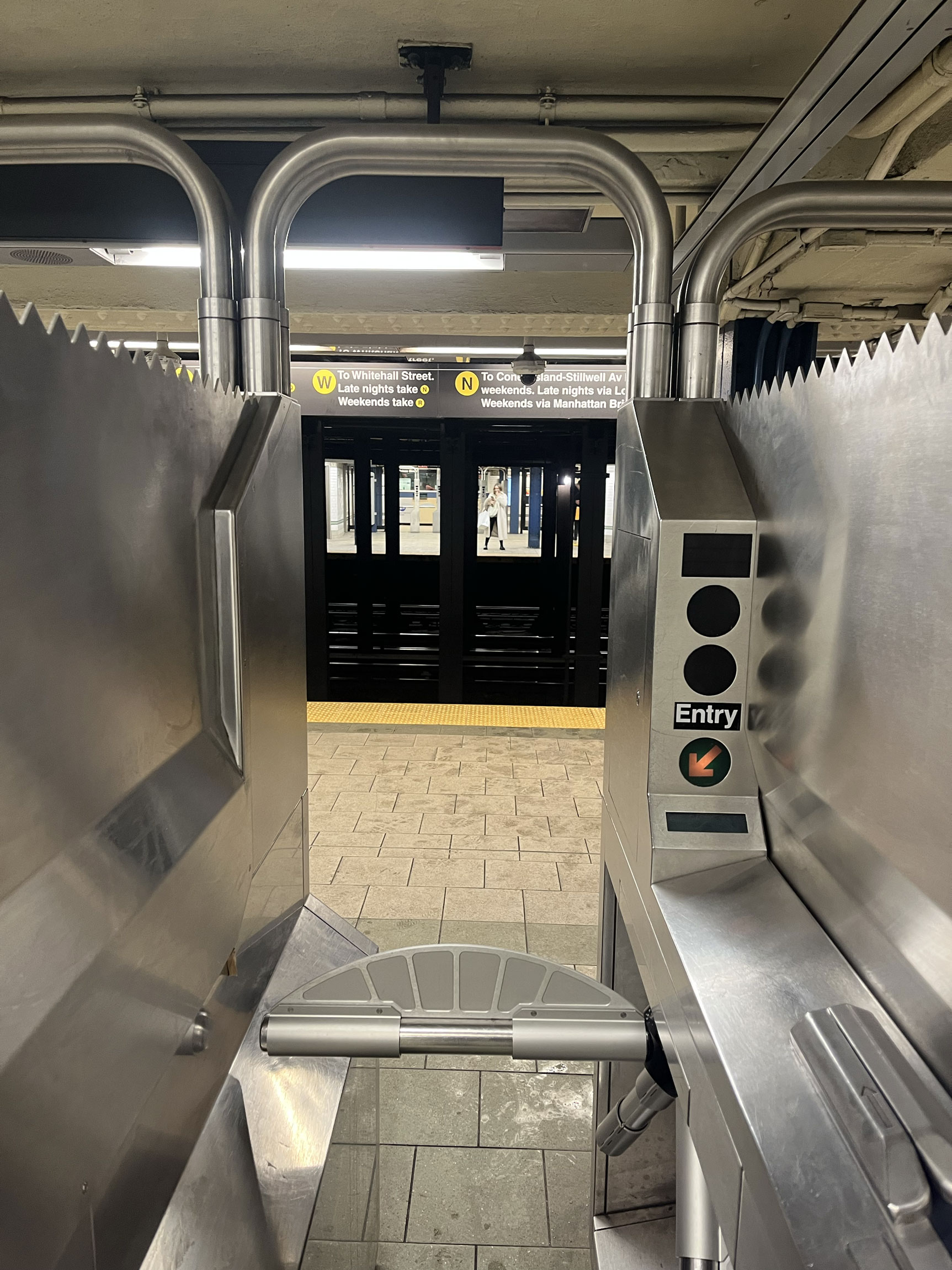
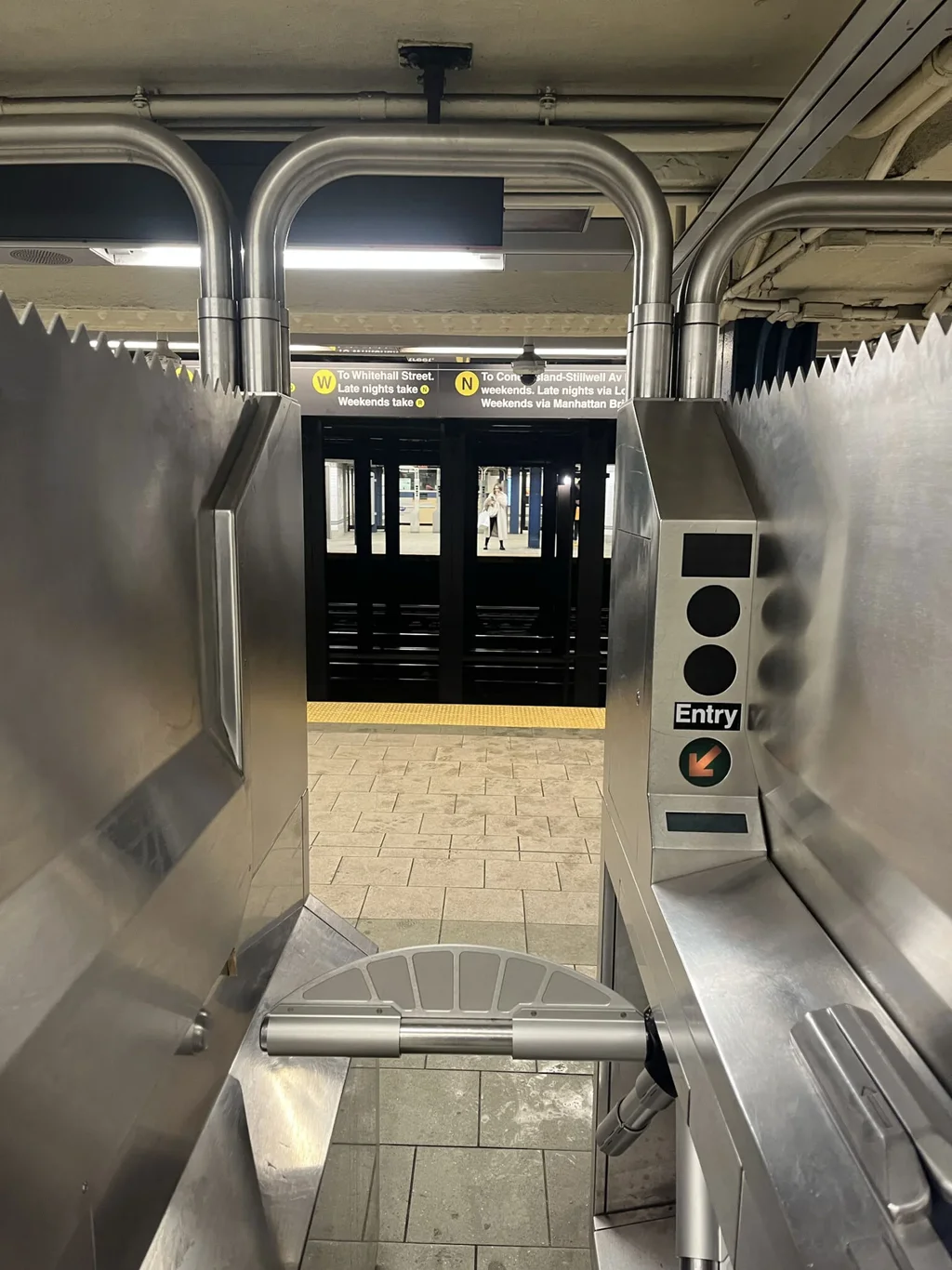
The New York City Subway workforce is composed of thousands of train operators, station clerks, track workers . . . and turnstiles. The system counts about 3,800 of the latter, working around the clock to direct passengers to train tracks and, above all, collect the $3.00 fare. Last year, these frontline workers adopted a new uniform to enhance their field performance against fare beaters. Turnstile arms were outfitted with metal, crescent-shaped epaulets, and each side of the gate adopted a new spiked barricade topper — in a plate-armor-inspired makeover.

These armored gates are part of a soldierly strategy to tackle revenue losses from fare and toll evasion ($1 billion in 2024). The City and State seem to be addressing this issue as a threat to national security. Former Mayor Eric Adams and Commissioner Jessica Tisch ordered police officers to patrol the subway and ticket toll-jumping riders. Governor Kathy Hochul deployed the National Guard to enhance safety, and the MTA is fortifying its turnstiles to battle fare evasion.

At first encounter, the turnstiles’ spiked teeth feel hard to reach and uncomfortable to touch, ringing the subway station like castle crenellations. In practice, they can be easily used to gain leverage without a trebuchet or other siege technology. It seems like a costume from a medieval-themed amusement park meant to appear harmful, but in fact, it is not. Countless videos on social mediashow it’s still possible to jump — using gloves, crawling, taking long steps — or walk freely through the emergency exit. More than military equipment, the fortified turnstiles resemble BDSM paraphernalia, pushing riders to be widely creative in their use.

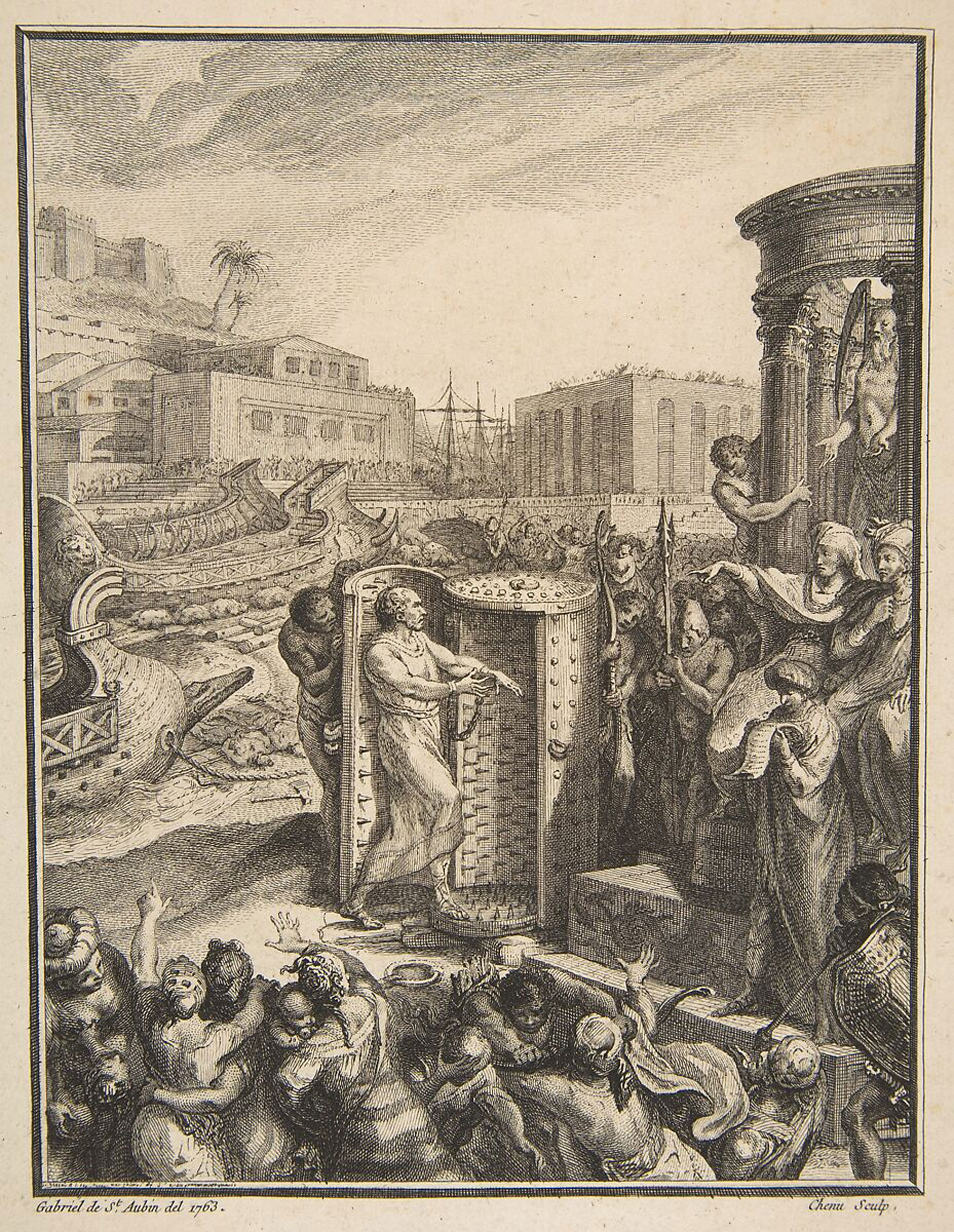
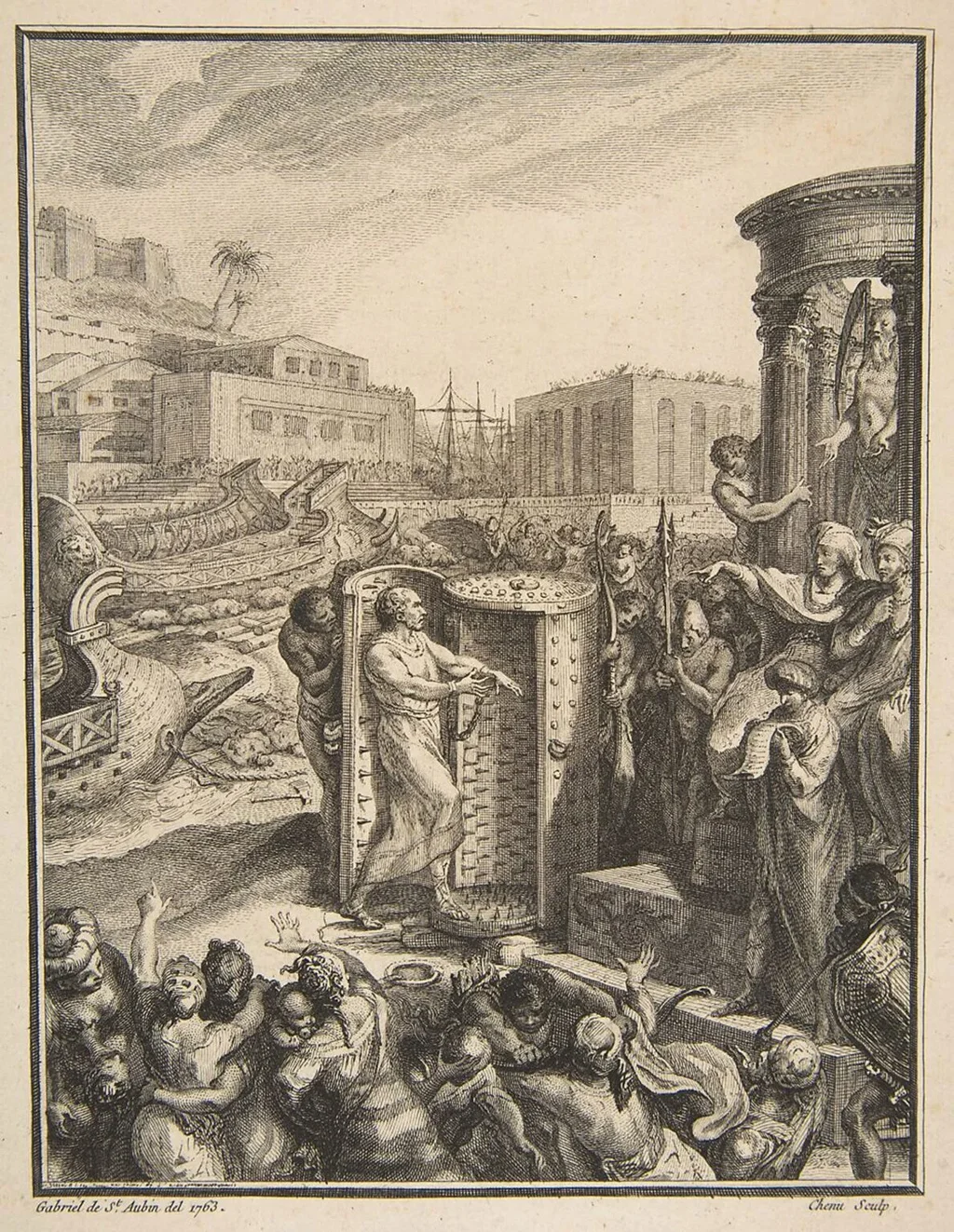
It is not the first time turnstiles seem to come out of the Met’s collection of medieval armor — or the wardrobe of a dominatrix. In 1931, the subway introduced a new turnstile design for stations without human agents: a metal floor-to-ceiling caged door. Riders would add a nickel at the entrance and push the revolving door to arrive at the train platform, minimizing interaction with train staff. The device, which would often trap passengers inside the cage, ultimately gained the nickname “Iron Maiden” after the most horrible torture device ever imagined.
<i>Regulus Condemned to the Most Horrible Torture</i>. Image via <a href=https://www.metmuseum.org/pt/art/collection/search/375895 target=blank>The Metropolitan Museum of Art</a>, bequest of William S. Lieberman, 2005
Regulus Condemned to the Most Horrible Torture. Image via The Metropolitan Museum of Art, bequest of William S. Lieberman, 2005

Setting aside the occasional injury or trapped passenger, the primary motivation for all new turnstile designs has been efficiency in collecting fares and combating evasion: adjusting the size of slips to make it harder to accept slugs, or introducing new payment media to deter people from stealing fare boxes. The last mass turnstile change came with the introduction of the MetroCard and new gates in 1993. To accomplish this, the City commissioned Cubic Corporation, a multinational company specializing in both military and public transportation technology. The new device was meticulously designed to prevent fare beating, featuring sharply slanted sides to reduce leverage for jumping and a slim, 15-inch-wide passageway to deter crawling and “backcocking.”

In a way, the current plate armor add-ons have been effective. Last September, the MTA reported a 29 percent drop in subway fare evasion, attributing it to the combined effect of new turnstile designs, patrolling emergency exits with unarmed guards, and aggressive ticketing. The agency is now turning its attention to its buses, deploying a civilian corps of fare inspectors who roam the lines at random.

At length, the fare gates wear their new armors not to attack, but to defend themselves. The problem with this approach is that it sees the rider trying to jump the turnstile as an assailant, avoiding really understanding why someone is not paying the fare. The crenellations do not address common complaints that erode trust in the subway system, like delays and service reliability, nor do they make it easier for people who cannot afford the $3.00 fare to access public transit. Instead, the fortified turnstiles are the material manifestation of a securitization politics that suggests that social issues can be policed away. Their armor continues to signal that the response to budget and policy debates involves deploying military technology rather than finding ways to make the service more affordable and dignified.
Photo by Ming Lin
Photo by Ming Lin

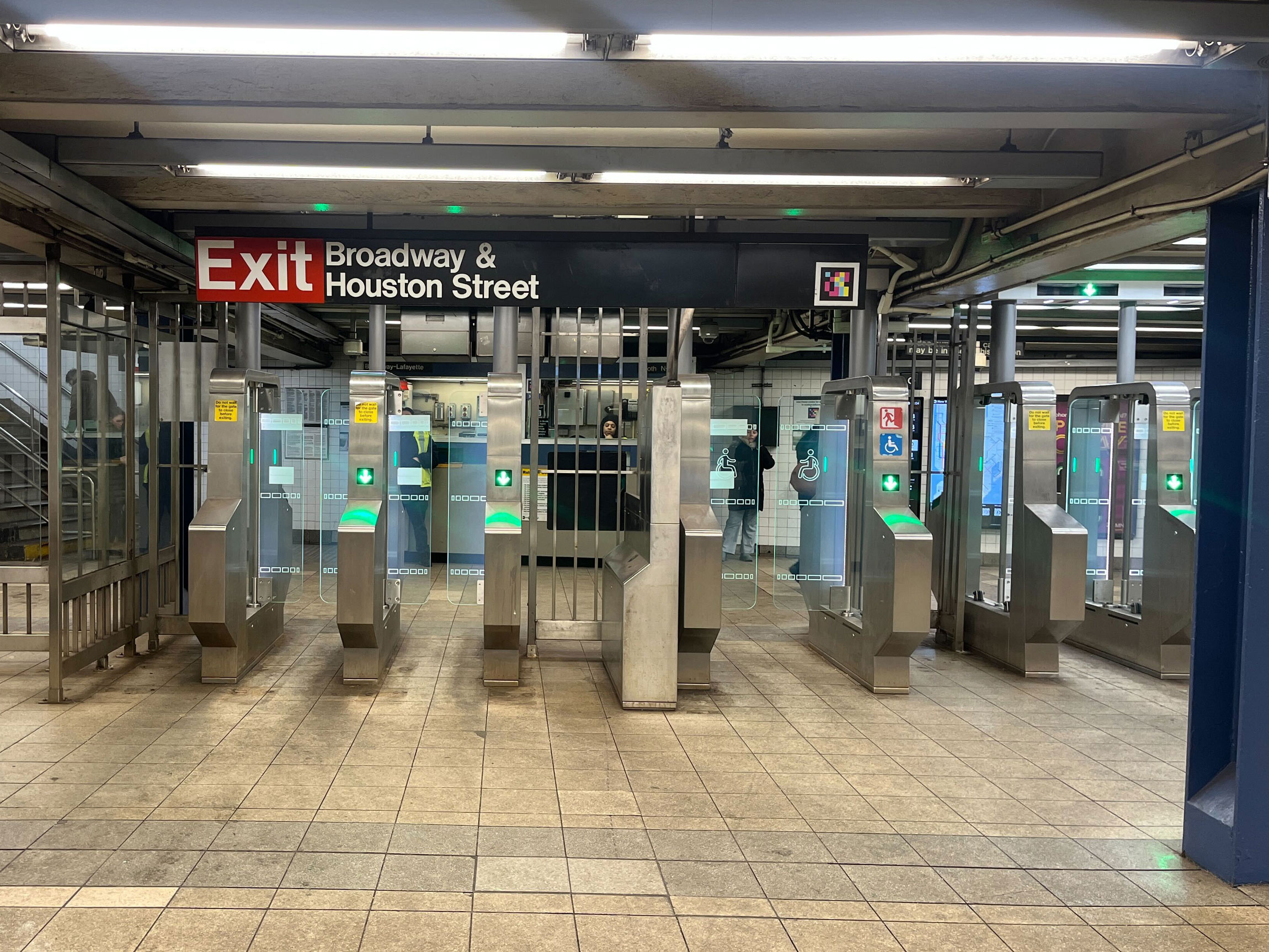
Now that the scale armor has reached almost all of the city’s 472 subway stations, the MTA is piloting several new fare gate designs in 20 locations to determine the best one to roll out to the entire system. The agency is investing another$1.1 billion to change 150 fare gates by 2029 with the goal to “improve fare compliance, system accessibility and passenger flow.” Manhattan’s Broadway-Lafayette Station is the first to test high-tech, plexiglass fare gates embedded with special sensors and AI technology, which are allegedly even harder to evade. During their first days on duty, the sci-fi saloon-style doors have trapped riders, and New Yorkers have already begun experimenting with new ways to hop, dodge, and slide.

Corporate or medieval, mid-century modern or wild west, people seem to always find a way to jump the turnstiles. Rather than deterring riders from fare evasion, aesthetic makeovers ultimately push people’s imaginations to find new ways to resist. The knight is met with Robin Hood-style antics. Redesigning turnstiles, one budget crisis after another, seems like a game impossible to win. Instead of outfit changes, perhaps the time has come for a shift in direction for our civic imagination. If we started the conversation about making buses free, it might be time for us to dream of decommissioning turnstiles after a hundred years of service.

Kaynak:Medieval Times - Urban Omnibus
 
Konu sahibi
Türkçe Çeviri (DeepL);

Orta Çağ Zamanları
Lucas Vaqueiro

28 Ocak 2026

IMG_9561.jpeg
Fotoğraf: Urban Omnibus

New York City Metro işgücü, binlerce tren operatörü, istasyon memuru, ray işçisi ve turnikelerden oluşmaktadır. Sistem, yolcuları tren raylarına yönlendirmek ve her şeyden önce 3,00 dolarlık ücretleri tahsil etmek için 24 saat çalışan yaklaşık 3.800 turnikeden oluşmaktadır. Geçen yıl, bu ön saflarda çalışanlar, kaçak yolcularla mücadelede saha performanslarını artırmak için yeni bir üniforma benimsedi. Turnike kollarına metal, hilal şeklinde apoletler takıldı ve kapının her iki tarafına da yeni sivri uçlu barikat üstü takıldı — zırhlı plakadan esinlenerek yeniden tasarlandı. Bu zırhlı kapılar, bilet ve geçiş ücreti kaçakçılığından kaynaklanan gelir kayıplarını (2024'te 1 milyar dolar) önlemek için askeri bir stratejinin parçasıdır. Belediye ve Eyalet, bu sorunu ulusal güvenliğe yönelik bir tehdit olarak ele alıyor gibi görünüyor. Eski Belediye Başkanı Eric Adams ve Komisyon Üyesi Jessica Tisch, polis memurlarına metroda devriye gezip kaçak yolcuları cezalandırmalarını emretti. Vali Kathy Hochul, güvenliği artırmak için Ulusal Muhafızları görevlendirdi ve MTA, kaçak yolculukla mücadele etmek için turnikelerini güçlendiriyor. İlk bakışta, turnikelerin sivri dişleri ulaşılması zor ve dokunulması rahatsız edici görünüyor ve metro istasyonunu kale siperleri gibi çevreliyor. Pratikte, mancınık veya diğer kuşatma teknolojileri olmadan kolayca kaldıraç olarak kullanılabilirler. Ortaçağ temalı bir eğlence parkındaki, zararlı görünmesi amaçlanan bir kostüm gibi görünüyor, ancak aslında öyle değil. Sosyal medyada sayısız video, eldiven kullanarak, emekleyerek, uzun adımlar atarak atlamanın veya acil çıkıştan serbestçe geçmenin hala mümkün olduğunu gösteriyor. Güçlendirilmiş turnikeler askeri teçhizattan çok, BDSM aksesuarlarına benziyor ve yolcuları kullanımlarında oldukça yaratıcı olmaya itiyor. Turnikelerin Met'in ortaçağ zırh koleksiyonundan veya bir dominatrix'in gardırobundan çıkmış gibi görünmesi ilk kez olmuyor. 1931'de metro, insan görevlisi olmayan istasyonlar için yeni bir turnike tasarımı getirdi: metal, yerden tavana kadar uzanan kafesli bir kapı. Yolcular girişte bir nikeli (madeni para) atıp döner kapıyı iterek tren platformuna ulaşıyor ve tren personeli ile etkileşimi en aza indiriyorlardı. Yolcuları sık sık kafesin içinde hapseden bu cihaz, sonunda hayal edilebilecek en korkunç işkence aletinin adını alarak “Iron Maiden” (Türkçeye çeviremedim) lakabını aldı.
IMG_9562.jpeg
. <i>En Korkunç İşkenceye Mahkum Edilen Regulus (Regulus Condemned to the Most Horrible Torture)</i>. Görsel: The Metropolitan Museum of Art (After Gabriel de Saint-Aubin - Regulus Condemned to the Most Horrible Torture - The Metropolitan Museum of Art), William S. Lieberman'ın vasiyeti, 2005

Ara sıra meydana gelen yaralanmalar veya sıkışan yolcular bir yana, tüm yeni turnike tasarımlarının temel motivasyonu, ücretlerin tahsilinde ve kaçak yolculuğun önlenmesinde verimlilik olmuştur:
sahte paraların kabul edilmesini zorlaştırmak için biletlerin boyutunu ayarlamak veya insanların ücret kutularını çalmasını engellemek için yeni ödeme araçları getirmek. Son toplu turnike değişikliği, 1993 yılında MetroCard ve yeni kapıların kullanıma girmesiyle gerçekleşti. Bunu başarmak için, şehir, hem askeri hem de toplu taşıma teknolojisinde uzmanlaşmış çok uluslu bir şirket olan Cubic Corporation'a görev verdi. Yeni cihaz, ücret kaçakçılığını önlemek için titizlikle tasarlandı ve atlamayı engellemek için keskin bir şekilde eğimli kenarlara ve sürünmeyi ve “geriye doğru atlamayı” engellemek için 15 inç genişliğinde dar bir geçide sahipti.

Bir bakıma, mevcut plaka zırhı eklemeleri etkili olmuştur. Geçen Eylül ayında, MTA metroda bilet kaçakçılığının yüzde 29 azaldığını bildirmiş ve bunu yeni turnike tasarımları, silahsız güvenlik görevlileriyle acil çıkışların devriye gezilmesi ve agresif bilet kesme uygulamalarının birleşik etkisine bağlamıştır. Kurum şimdi dikkatini otobüslere çevirerek, hatlarda rastgele dolaşan sivil bilet denetçileri ekibi görevlendirmiştir.

Sonuç olarak, turnikeler yeni zırhlarını saldırmak için değil, kendilerini savunmak için giyiyorlar. Bu yaklaşımın sorunu, turnikeden atlamaya çalışan yolcuyu bir saldırgan olarak görmesi ve birisinin neden ücret ödemediğini gerçekten anlamaya çalışmamasıdır. Siperlikler, güveni zedeleyen yaygın şikayetleri ele almıyor.
Gecikmeler ve hizmet güvenilirliği gibi metro sistemine olan güveni sarsan yaygın şikayetleri gidermiyor, ayrıca 3 dolarlık ücretini ödeyemeyen kişilerin toplu taşıma araçlarına erişimini kolaylaştırmıyor. Bunun yerine, güçlendirilmiş turnikeler, sosyal sorunların polis gücüyle çözülebileceğini öne süren bir güvenlik politikasının somut bir tezahürüdür. Bu zırhlar, bütçe ve politika tartışmalarına verilen yanıtın, hizmeti daha uygun fiyatlı ve saygın hale getirmenin yollarını bulmak yerine askeri teknolojinin kullanılması olduğunu göstermeye devam etmektedir.


Photo by Ming Lin
Ming Lin’e ait bir fotoğraf.

Ölçekli zırhlar şehrin 472 metro istasyonunun neredeyse tamamına ulaştığına göre, MTA, tüm sisteme uygulanacak en iyi tasarımı belirlemek için 20 lokasyonda birkaç yeni bilet kapısı tasarımını deniyor. Kurum, “bilet kurallarına uyumu, sistem erişilebilirliğini ve yolcu akışını iyileştirmek” amacıyla 2029 yılına kadar 150 bilet kapısını değiştirmek için 1,1 milyar dolarlık ek yatırım yapıyor. Manhattan'daki Broadway-Lafayette İstasyonu, özel sensörler ve yapay zeka teknolojisi ile donatılmış, kaçmanın daha da zor olduğu iddia edilen yüksek teknolojili pleksiglas bilet kapılarını test eden ilk istasyon oldu. Göreve başladıkları ilk günlerde, bilim kurgu filmlerindeki salon kapıları gibi görünen bu kapılar yolcuları kapana kıstırdı ve New Yorklular atlamak, kaçmak ve kaymak için yeni yöntemler denemeye başladı bile.

Kurumsal veya ortaçağ, yüzyıl ortası modern veya vahşi batı, insanlar her zaman turnikelerden atlamak için bir yol buluyor gibi görünüyor. Estetik değişiklikler, yolcuları ücret kaçakçılığından caydırmak yerine, nihayetinde insanların direnmek için yeni yollar bulma hayal gücünü harekete geçiriyor. Şövalye, Robin Hood tarzı hareketlerle karşılaşıyor. Birbiri ardına gelen bütçe krizleri arasında turnikelerin yeniden tasarlanması, kazanılması imkansız bir oyun gibi görünüyor. Kıyafet değişiklikleri yerine, belki de sivil hayal gücümüzün yönünü değiştirme zamanı gelmiştir. Otobüsleri ücretsiz hale getirme konusunu gündeme getirdiysem, yüz yıllık hizmetin ardından turnikelerin hizmetten kaldırılmasını hayal etmenin zamanı gelmiş olabilir.


çeviride bir hata varsa söyleyebilirsiniz. Elimden geldiğince çeviriyi denetledim ama gözümden bazı şeyler kaçmış olabilir
 

Daylighting türlerinden örneğe devam edelim dedim.​

Bike Daylighting​

Nov 20, 2024
Graphic showing the difference between no daylighting and bike daylighting.

Clearing the curb space next to a crosswalk and upgrading that space with on-street bike parking racks and secure bike parking stations benefits neighborhoods with limited bike parking and sidewalk space, and a high percentage of bike commuters, bike lanes, and residents living in poverty (as biking reduces transportation costs and overcrowded housing may leave less space to store a bike at home). Installing bike parking keeps bikes off the sidewalk, improves curb access for drivers and passengers, and is an ideal solution for dense residential neighborhoods, commercial corridors, and outside subway stations.

Case Study: Far Rockaway, Queens​

The neighborhood of Far Rockaway, Queens has less bike parking per resident than most neighborhoods in New York City, with just 6% as many bike parking spaces as in the average neighborhood. With below-average sidewalk space limiting room for bike parking on the sidewalk and an above-average number of residents living below the poverty line — limiting space to store bicycles at home — Far Rockaway residents would dramatically benefit from installing bike daylighting at every intersection.
Graphic showing bike daylighting.


Kaynak:Bike Daylighting — Transportation Alternatives

Bence Odunpazarı, Ankara gibi hem genç hem öğrenci nüfusunun yoğun ve toplu taşımanın sıkıntılı olduğu yerlere yapılabilir.
Sadece Ankara'nın değil, Düzlükler üzerine kurulmuş her yerde yapılması gerekiyor.

Bisikletlerle ulaşım, araba ve otobüsün ötesinde bir yere yürüyerek gitmekten bile verimli. Böylece 1 araba park yeri yerine en az 8 adet bisiklet park edilebilir. Kaynak olarak wikipedia veriyorum ancak veriler makaleler ile desteklenmiş.

Başka bir daylighting türü:

Bus Daylighting​

Nov 20, 2024
GIF of different types of daylighting.

Clearing the curb space next to a crosswalk and upgrading that space with sheltered bus boarding and waiting areas benefits neighborhoods with a high percentage of parents of young children, older or disabled residents, a high number of bus commuters and bus lanes, slow bus speeds, limited sidewalk space, and high surface temperatures. Installing bus boarding areas allows buses to pick up passengers without weaving in and out of traffic and alleviates the need to step off the curb before climbing onto the bus. This makes the bus more accessible to all ages and abilities, speeds up bus commutes, and makes bus rides smoother and bus movements more predictable.

Case Study: Crotona Park East, the Bronx​

The neighborhood of Crotona Park East has some of New York City’s slowest bus speeds, averaging just 6.5 mph. With nearly twice as many residents commuting by bus as the citywide average, one in four residents living below the poverty line, and summer surface temperatures of 100 °F, Crotona Park East residents would dramatically benefit from installing bus daylighting at every intersection along its bus routes to protect bus riders from the elements while reducing their wait time.
Graphic showing bus daylighting.


Kaynak: Bus Daylighting — Transportation Alternatives

Sizce bu türkiyede nereye uygun olurdu? @kısayolunuzunu @Rick Grimes
Ayrılmamış otobüs cebi olan bütün otobüs duraklarında, mevcuttaki otobüs ceplerini şoförler ya cebi düzgün kullanmıyor ya da hatalı parklanma nedeni ile kullanamıyor, her türlü durumda en sağ şerit yine tıkanmış oluyor.
Böyle olur ise hem daha fazla park alanı olur hem de otobüsler şeride geri girmeye çalışırken zorlanmazlar.

Cool & Clean Daylighting​

Nov 20, 2024
Gif cycling through different daylighitng.

Clearing the curb space next to a crosswalk and upgrading that space with trees, plantings, or other greenery benefits neighborhoods with limited park access and tree canopy, high surface temperatures, and high rates of asthma, air pollution, and noise pollution. Planting even one street tree can remove the equivalent of 11,000 miles of car emissions every year.

Case Study: Laurelton, Queens​

The neighborhood of Laurelton is one of the hottest neighborhoods in New York City and has some of the least access to parks, with only around one in five residents living within walking distance of a park" With some of New York City’s highest levels of noise pollution, only 19% of its surface area covered by tree canopy, and average summer surface temperatures of 102 °F, Laurelton residents would dramatically benefit from installing cool and clean daylighting at every intersection.
Graphic showing cool & clean daylighting.


Kaynak:Cool & Clean Daylighting — Transportation Alternatives

Tam Zonguldak'a uygun. Türkiye'nin havası en kirli şehirlerinden. İstanbul'da da Esenyurt, Avcılar, Sultangazi gibi tamamen beton ve araç trafiği yüksek yerlere uygun olur.
Beton şehirlerimiz için olması gereken bu zaten de işte.
 
Konu sahibi
Bize en ütopik kaçacak daylighting türü. Sonuncusu çevirmek için verdiğim emeğe rağmen hiç ilgi görmediği için biraz salmıştım da @kısayolunuzunu sayesinde bir tane daha paylaşmaya karar verdim:

Safe Streets Daylighting​

Nov 20, 2024
GIF cycling through different types of daylighting.

Clearing the curb space next to a crosswalk and upgrading that space with curb extensions benefits neighborhoods with a high percentage of parents of young children, older or disabled residents, high rates of traffic fatalities, traffic injuries, and large traffic volumes. Widening sidewalks at intersections shortens the distance that pedestrians need to cross, reduces speeding, and makes pedestrians more visible and drivers more likely to yield to pedestrians.

Case study: Hunts Point, the Bronx​

The neighborhood of Hunts Point has more traffic fatalities and serious injuries than any neighborhood in New York City. With a rate of traffic fatalities nearly eight times higher than the citywide average, Hunts Point residents would dramatically benefit from safe streets daylighting at every intersection. Industrial neighborhoods such as Hunts Point especially benefit from the increased visibility offered by daylighting (as the high hoods and long footprints of trucks block crosswalk visibility and limit driver line-of-sight even more than passenger vehicles).

Graphic showing safe daylighting.


DeepL Türkçe çeviri:

Güvenli Sokaklar Kaldırım Uzantısı


Yaya geçidinin yanındaki kaldırım alanını temizlemek ve bu alanı kaldırım uzantıları ile iyileştirmek, küçük çocuklu ebeveynlerin, yaşlı veya engelli sakinlerin oranının yüksek olduğu, trafik kazalarında ölüm ve yaralanma oranlarının yüksek olduğu ve trafik yoğunluğunun fazla olduğu mahalleler için faydalıdır. Kavşaklarda kaldırımların genişletilmesi, yayaların geçmesi gereken mesafeyi kısaltır, hızı azaltır, yayaları daha görünür hale getirir ve sürücülerin yayalara yol verme olasılığını artırır.

Vaka çalışması: Hunts Point, Bronx

Hunts Point mahallesi, New York şehrindeki diğer mahallelerden daha fazla trafik kazası ve ciddi yaralanma vakasına sahne olmaktadır. Şehir ortalamasının neredeyse sekiz katı trafik kazası oranına sahip olan Hunts Point sakinleri, her kavşakta güvenli sokak kaldırım uzantısından büyük fayda sağlayacaktır. Hunts Point gibi endüstriyel mahalleler, kaldırım uzantısının sağladığı artan görünürlükten özellikle faydalanır (çünkü kamyonların yüksek kaputları ve uzun ayak izleri, yaya geçitlerinin görünürlüğünü engeller ve sürücülerin görüş alanını binek araçlardan daha fazla sınırlar).
 
Bize en ütopik kaçacak daylighting türü. Sonuncusu çevirmek için verdiğim emeğe rağmen hiç ilgi görmediği için biraz salmıştım da @kısayolunuzunu sayesinde bir tane daha paylaşmaya karar verdim:

Safe Streets Daylighting​

Nov 20, 2024
GIF cycling through different types of daylighting.

Clearing the curb space next to a crosswalk and upgrading that space with curb extensions benefits neighborhoods with a high percentage of parents of young children, older or disabled residents, high rates of traffic fatalities, traffic injuries, and large traffic volumes. Widening sidewalks at intersections shortens the distance that pedestrians need to cross, reduces speeding, and makes pedestrians more visible and drivers more likely to yield to pedestrians.

Case study: Hunts Point, the Bronx​

The neighborhood of Hunts Point has more traffic fatalities and serious injuries than any neighborhood in New York City. With a rate of traffic fatalities nearly eight times higher than the citywide average, Hunts Point residents would dramatically benefit from safe streets daylighting at every intersection. Industrial neighborhoods such as Hunts Point especially benefit from the increased visibility offered by daylighting (as the high hoods and long footprints of trucks block crosswalk visibility and limit driver line-of-sight even more than passenger vehicles).

Graphic showing safe daylighting.


DeepL Türkçe çeviri:

Güvenli Sokaklar Kaldırım Uzantısı


Yaya geçidinin yanındaki kaldırım alanını temizlemek ve bu alanı kaldırım uzantıları ile iyileştirmek, küçük çocuklu ebeveynlerin, yaşlı veya engelli sakinlerin oranının yüksek olduğu, trafik kazalarında ölüm ve yaralanma oranlarının yüksek olduğu ve trafik yoğunluğunun fazla olduğu mahalleler için faydalıdır. Kavşaklarda kaldırımların genişletilmesi, yayaların geçmesi gereken mesafeyi kısaltır, hızı azaltır, yayaları daha görünür hale getirir ve sürücülerin yayalara yol verme olasılığını artırır.

Vaka çalışması: Hunts Point, Bronx

Hunts Point mahallesi, New York şehrindeki diğer mahallelerden daha fazla trafik kazası ve ciddi yaralanma vakasına sahne olmaktadır. Şehir ortalamasının neredeyse sekiz katı trafik kazası oranına sahip olan Hunts Point sakinleri, her kavşakta güvenli sokak kaldırım uzantısından büyük fayda sağlayacaktır. Hunts Point gibi endüstriyel mahalleler, kaldırım uzantısının sağladığı artan görünürlükten özellikle faydalanır (çünkü kamyonların yüksek kaputları ve uzun ayak izleri, yaya geçitlerinin görünürlüğünü engeller ve sürücülerin görüş alanını binek araçlardan daha fazla sınırlar).
Yayalar için komple ayrım dışında en güvenlisi bu olması lazım ama araç sürerken benim en nefret ettiğim yaya geçidi tipidir.
Özellikle İzmir/Alsancak'taki o yol yaklaşık 6 metre uzunluğunda olduğundan her şey birbirine karışıyor.

Bunun ile birlikte yol da karşı geçirtmeye zorlayan duba/ extensionlardan nefret ediyorum. Çok şükür ki ülkemizdeki yollarda öyle bir örneği yok.
(Bahsettiğim extensionlar)
 
Konu sahibi
Yayalar için komple ayrım dışında en güvenlisi bu olması lazım ama araç sürerken benim en nefret ettiğim yaya geçidi tipidir.
Özellikle İzmir/Alsancak'taki o yol yaklaşık 6 metre uzunluğunda olduğundan her şey birbirine karışıyor.

Bunun ile birlikte yol da karşı geçirtmeye zorlayan duba/ extensionlardan nefret ediyorum. Çok şükür ki ülkemizdeki yollarda öyle bir örneği yok.
(Bahsettiğim extensionlar)
Bu aracı görünce takla atmaya meyilli ilk mercedes B sınıfı geldi
 
Konu sahibi

Uzun yazılarda türkçe çeviri zor olduğu için bunu çevirmeyeceğim.​

Toronto: What Eglinton Means​

9 Şubat 2026

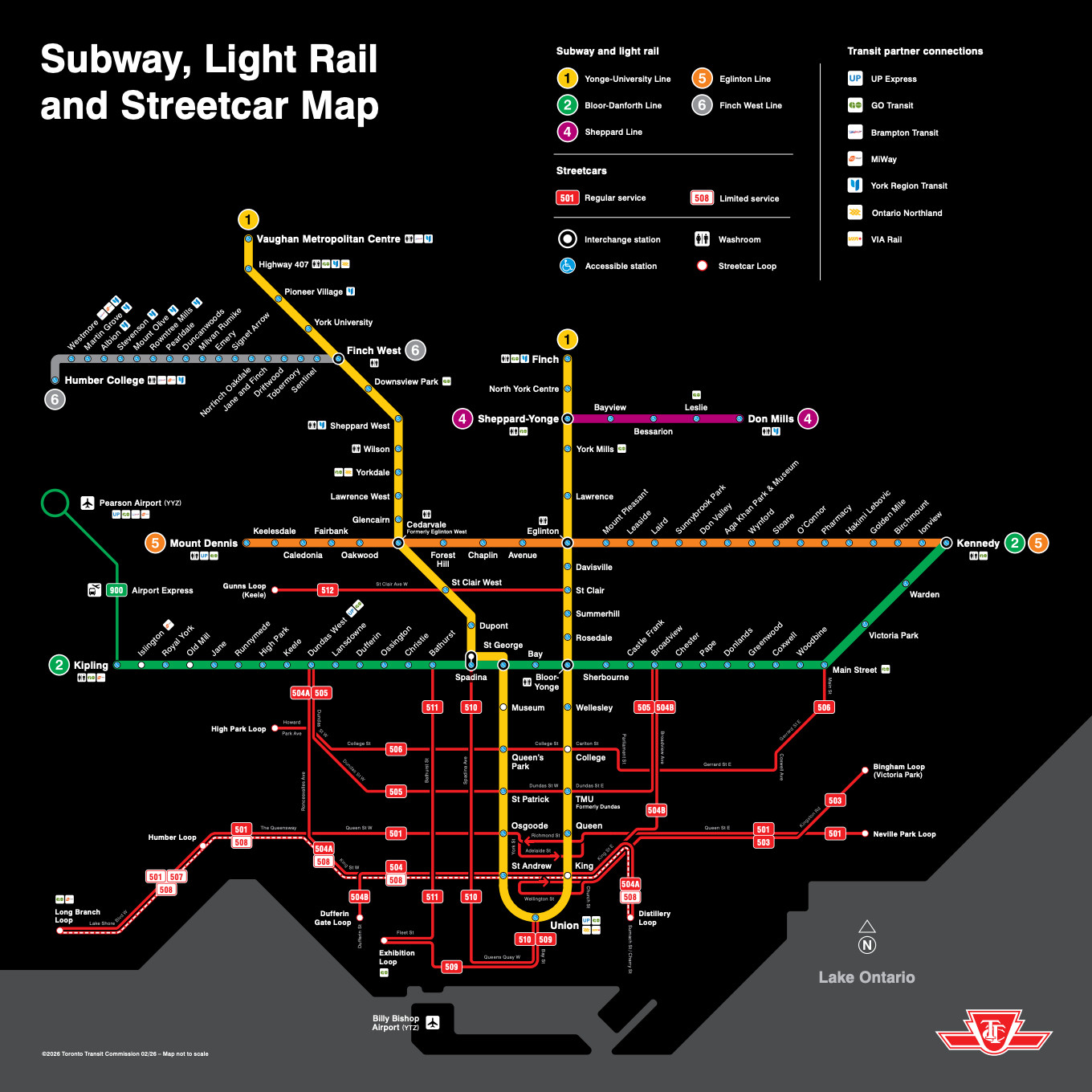
It’s been a long struggle, but Toronto’s Eglinton rail line is finally open. Now, the rapid transit network consists of the wide lines on this map, numbered 1-6.


New rail map published by the Toronto Transit Commission, showing the new Eglinton line as Line 5. Please ignore the narrow lines numbered in the 500s. They are streetcars, and many of them are stuck in traffic and slower than buses.

The internet is full of reviews and recriminations about how long Eglinton took and the pros and cons of its design, but I want to make a different point: Eglinton shows a city slowly awakening to its true nature as a grid. This awakening is ultimately more important for the mobility and freedom of people in Toronto than details of what’s on rails and what’s on tires.

Toronto, like Chicago, is a grid city with a very uneven distribution of density. The city has a large grid of arterials that are more or less c0ntinuous across the city, but density is historically concentrated downtown and to some degree along the oldest rail transit corridors, especially Yonge (the east leg of Line 1).

So for a long time it wasn’t crazy for Toronto, like Chicago, to have a radial rail network (designed mostly for trips downtown) fed by buses that followed the arterial grid.

But it’s crazy now. Working from home has reduced the rush of commuters into the downtown towers. Meanwhile, many more towers are being built in the suburbs, often just over the line outside Toronto. And as in every city, the preponderance of travel demand is now much more all-day, all-week and all-direction than it used to be. Finally, lower-income people have always been less likely to be going downtown, and more likely to be accessing lower-wage jobs that are scattered all over the city. So if we care about them, we have to stop building and planning as though downtown is all that really matters.

So Toronto needs a network that people can use to go anywhere at any time.

The downtown-oriented network is not good at this, because by feeding toward downtown in a hierarchical pattern, it makes it hard to travel in non-downtown directions. In short, Toronto needs a grid transit network to match its grid geography, so that people can go from anywhere to anywhere in a simple L-shaped trip, usually with a single transfer.

Eglinton is the first major investment that shows a stirring of that consciousness. It lies well north of downtown, and runs east-west most of the way across the city. For the first time, it’s possible to travel a long distance east-west without transferring and without going downtown, which means that trips to many other places become possible with one transfer instead of two or three.

But the old consciousness is still on display further north on the map above, where the recent Finch West line (Line 6) has opened. It’s very much the old model of a hierarchical feeder, running from the west edge of the city only to the first subway connection. It’s now a mirror image of the equally problematic Line 4, which serves only a fragment of Sheppard on the east side. Both of these lines are largely useless for the kinds of trips that will increasingly prevail in a multi-dimensional city, because they interrupt the logic of the grid instead of working with it. My advice to Toronto years ago was not to build Finch West until they were ready to continue it all the way east at least to Yonge, the east leg of Line 1, so that it could also be used to travel to points on Yonge including northward into the dense suburbs. It will be interesting to see how useful the newly opened fragment turns out to be.

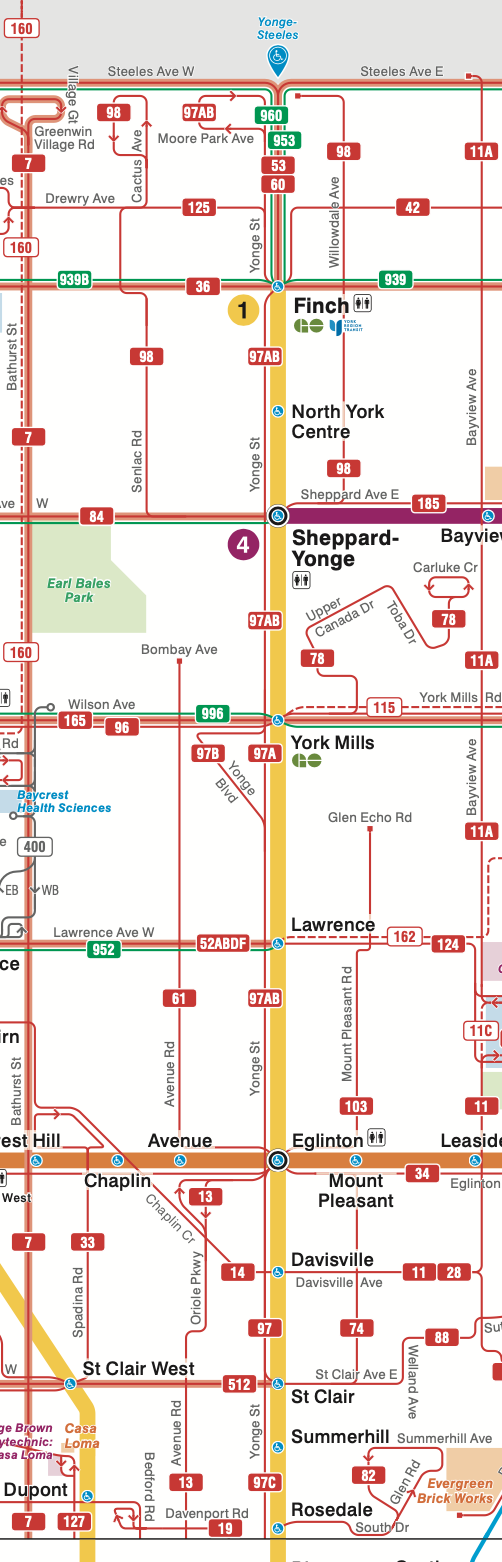
The buses, too, still display the old consciousness. Almost without exception, long east-west lines terminate at Yonge, requiring the passenger to transfer to continue in the same direction on the same street. Again, this means they will often transfer twice to complete an L-shaped trip to an actual non-downtown destination:


A segment of the Toronto bus map along Yonge Avenue from the north edge of downtown to the north edge of the city. Note that every east-west line is interrupted here. Eglinton rail (orange) is the only exception.

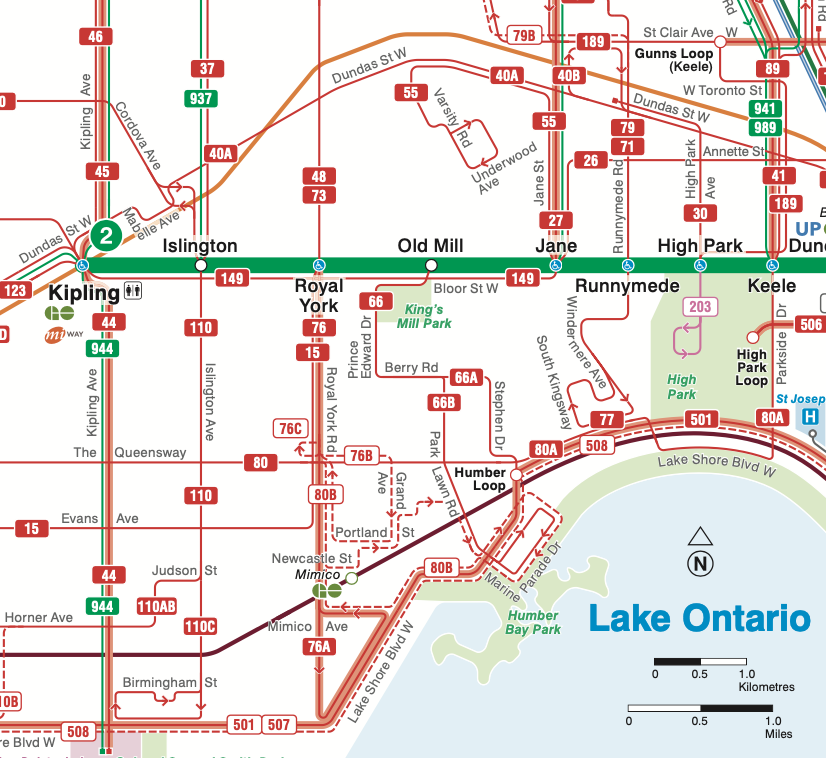
The situation is even more remarkable along the Bloor-Danforth subway Line 2, where again many bus routes are interrupted. Toronto is about twice as big east-west as north-south, so these corridors are shorter, which means there’s even less reason to interrupt them:


The west end of Line 2. Note that every north-south bus line is interrupted as it crosses the rail line, adding many unnecessary transfers to L-shaped trips that do not use the rail.

These designs reflect an obsolete notion of hierarchy in which rail is king and buses are servants, existing only to “feed” the rail. In an era when downtown commuters mattered more than anyone, that made a bit of sense, but only a bit. There were always people trying to go everywhere and struggling against these patterns. Now, buses need to be rethought to make sense on their own terms, as parts of complete grid networks. (Our firm brought the same awareness to the upcoming redesign of Atlanta’s MARTA bus network, where for the first time, many bus routes will continue past rail stations instead of ending there)

So amid all the other debates about Toronto, let’s celebrate the most important thing about Eglinton: For almost the first time, the city has made a major investment that recognizes that in a big, dense city, surrounded by dense suburbs, people need to go all directions, all the time.

Kaynak: Toronto: What Eglinton Means — Human Transit
 
Son düzenleme:
Konu sahibi
Adamlar nasıl 100 sene şehir oluşturmadan yaşamışlar bize de lazım böyle kişiler. Türkçe çeviriyi ayrı bir mesaj olarak atacağım.

Bradfield City by SOM and Hassell

Plans unveiled for Australia's first new city in over 100 years

Starr Charles | 11 February 2026
American studio SOM and Australian studio Hassell have revealed plans for Bradfield City, a new, 114-hectare city in western Sydney, which is set to include 10,000 homes, a university campus and a two-hectare park.

Planned to be located beside the recently-completed Western Sydney International Airport, the Bradfield City masterplan proposes an urban landscape roughly 50 kilometres west of Sydney's central business district, conceptualised as "Sydney's new urban heart".

The masterplan forms one of Australia's largest urban development projects and, once complete, will be the country's first major city built in over a century, according to SOM.

Render of Bradfield City
SOM and Australian studio Hassell have revealed plans for Bradfield City in western Sydney

Key aspects of the development will include the creation of 10,000 new homes, a 2.2-kilometre Green Loop park, a two-hectare Central Park and four major civic centres.

SOM and Hassell designed the proposal in collaboration with cultural design partners Djinjama and COLA Studio to be an "inclusive and climate-resilient" city shaped by indigenous connections to Country – a term used by First Nations peoples to refer to the lands, waters and skies.

"To design a new city is both a rare opportunity and a profound responsibility," senior associate principal at SOM Michael Powell said.

"Bradfield City is a chance to shape a vision with Country and community, embedding resilience, sustainability, and innovation into every layer of the city."

Render of hotel within Australian city by SOM and Hassell
It will include 10,000 new homes, green areas and four major civic centres.


At the centre of the development, the First Land Release, also known as Superlot 1, will encompass a 5.7-hectare site described by SOM as Bradfield City's "civic heart".

This central area will be the proposal's first stage and is set to contain 1,400 homes alongside a university campus, offices, retail space, a hotel and public space.

Renders of the First Land Release depict a series of high-rise blocks situated along tree-lined streets and interspersed with expansive green areas.


Complementing the city's green areas, a timber pavilion will shelter a gathering space for the community beneath an interlocking timber structure and woven canopy.

According to SOM, this pavilion design draws on the Aboriginal principle of "enoughness" or taking only what is needed, with the studios opting for low-carbon and high-performance materials.

Bradfield City
The First Land Release will contain 1,400 homes.

Other sustainability strategies include the use of passive design solutions, green roofs and solar panels throughout the city's infrastructure to improve their environmental performance.

"We set out to create a precinct where nature and urban life are intertwined, ensuring Bradfield City feels welcoming, sustainable and uniquely of its place," principal at Hassell Kevin Lloyd said.

Green area within Bradfield City
The infrastructure will be paired with expansive green areas.


The Bradfield City development is being developed by developer Plenary and has been backed by more than $1 billion in Australian public investment. Its first stage of development is planned to roll out over the next five years.

Elsewhere in Australia, Cox Architecture and Hassell unveiled plans for the Brisbane Olympic Stadium, which is set to serve as the main venue for the 2032 games, and RSHP completed the Barangaroo South masterplan in Sydney.

The renders are courtesy of SOM.
[automerge]1771071742[/automerge]
Türkçe çeviri (DeepL):

Avustralya'nın 100 yılı aşkın süredir ilk yeni şehri için planlar açıklandı


Starr Charles | 11 Şubat 2026

Amerikalı stüdyo SOM ve Avustralyalı stüdyo Hassell, Sidney'in batısında 114 hektarlık bir alana kurulacak ve 10.000 konut, bir üniversite kampüsü ve iki hektarlık bir park içerecek olan Bradfield City için planlarını açıkladı.

Yakın zamanda tamamlanan Batı Sidney Uluslararası Havalimanı'nın yanına kurulması planlanan Bradfield City master planı, Sidney'in merkezi iş bölgesinin yaklaşık 50 kilometre batısında, “Sidney'in yeni kentsel kalbi” olarak tasarlanan bir kentsel peyzaj öneriyor.

SOM'a göre, ana plan Avustralya'nın en büyük kentsel gelişim projelerinden birini oluşturuyor ve tamamlandığında, ülkede bir asırdan fazla bir süredir inşa edilen ilk büyük şehir olacak.

Gelişimin temel unsurları arasında 10.000 yeni konut, 2,2 kilometrelik Green Loop parkı, iki hektarlık Central Park ve dört büyük sivil merkezin oluşturulması yer alıyor.

SOM ve Hassell, kültürel tasarım ortakları Djinjama ve COLA Studio ile işbirliği içinde, yerli halkların toprak, su ve gökyüzünü ifade etmek için kullandıkları bir terim olan “Country” ile yerli halkların bağları tarafından şekillendirilen “kapsayıcı ve iklime dirençli” bir şehir olması için bu öneriyi tasarladı.

SOM'un kıdemli ortağı Michael Powell, “Yeni bir şehir tasarlamak hem nadir bir fırsat hem de büyük bir sorumluluktur” dedi.

“Bradfield City, Country ve toplulukla birlikte bir vizyon oluşturma, şehrin her katmanına dayanıklılık, sürdürülebilirlik ve yenilikçilik katma fırsatı sunuyor.”

SOM ve Hassell tarafından Avustralya şehrinde tasarlanan otelin renderı Proje, 10.000 yeni konut, yeşil alanlar ve dört büyük sivil merkez içerecek.

Geliştirmenin merkezinde, Superlot 1 olarak da bilinen First Land Release, SOM tarafından Bradfield City'nin “kamu merkezi” olarak tanımlanan 5,7 hektarlık bir alanı kapsayacak.

Bu merkezi alan, teklifin ilk aşamasını oluşturacak ve 1.400 konutun yanı sıra bir üniversite kampüsü, ofisler, perakende alanları, bir otel ve kamusal alanları içerecek.

Şehrin yeşil alanlarını tamamlayan ahşap bir çardak, birbirine kenetlenen bir ahşap yapıyla dokunmuş bir kubbe altında topluluk için bir toplanma alanı barındıracak.

SOM'a göre, bu çardak tasarımı, Aborjinlerin “yeterlilik” ya da sadece ihtiyaç duyulanı alma ilkesinden esinlenerek, stüdyolar düşük karbonlu ve yüksek performanslı malzemeler tercih ediyor.

Diğer sürdürülebilirlik stratejileri arasında, çevresel performansı iyileştirmek için şehrin altyapısı genelinde pasif tasarım çözümleri, yeşil çatılar ve güneş panellerinin kullanılması yer alıyor.

Hassell'in müdürü Kevin Lloyd, “Bradfield City'nin misafirperver, sürdürülebilir ve kendine özgü bir yer olmasını sağlamak için doğa ve kent yaşamının iç içe geçtiği bir bölge yaratmaya karar verdik” dedi.

Bradfield City projesi, Plenary adlı geliştirici tarafından geliştirilmekte olup, 1 milyar Avustralya doları tutarında kamu yatırımı ile desteklenmektedir. Projenin ilk aşaması önümüzdeki beş yıl içinde hayata geçirilmesi planlanmaktadır.

Avustralya'nın başka bölgelerinde ise Cox Architecture ve Hassell, 2032 oyunlarının ana mekanı olacak Brisbane Olimpiyat Stadyumu'nun planlarını açıkladı ve RSHP, Sidney'deki Barangaroo South masterplanını tamamladı.

Renderlar SOM'un izniyle kullanılmıştır.

Kaynak: Plans unveiled for Australia's first new city in over 100 years
 
Son düzenleme:
Konu sahibi

Belçika’daki Leuven’de otonom shuttlelar ilk defa Belçika trafiğinde test edilmiş. EIT Urban Mobility fonlamış önemli bir çift diploma programıdır ulaşımda master yapmayı düşünenlere tavsiye ederim​

by Editorial | UTM
leuven-de-lijn-press-22-656x337.png


© De Lijn Press
Autonomous shuttle buses have been operating in Leuven’s city transport system since September 2025. Due to its complexity in the transport sector, this project is a Belgian first and part of a broader European collaboration in the field of sustainable mobility, made possible by funding from EIT Urban Mobility.

Two autonomous shuttles from manufacturer WeRide have been operating in Leuven city centre since 11 September 2025. Engineers from the company first programmed the software in the vehicles. They then mapped the city centre using existing camera and radar technology under the guidance of De Lijn drivers. After learning the traffic patterns and completing sufficient test kilometres, passengers have also been able to ride along since 22 January 2026. The buses achieve SAE Level 4 (L4). Legal requirements stipulate that a driver must remain on board during every journey.

© WeRide
Chinese autonomous driving technology company WeRide is based in Guangzhou – it was founded in 2017. The WeRide ‘Robobus’ used in Leuven were developed in collaboration with bus manufacturer Yutong, where they are known internally as the Yutong Model Xiaoyu 2.0. The buses can accommodate 8 passengers and receive information about the driving environment from 20 high-performance sensors.

The buses stop automatically at all stops. Passengers must wear a seat belt. To ride, interested parties must register digitally in advance as subscribers or purchase a standard ticket in advance via SMS or the De Lijn Ticket App. It is not possible to pay or scan tickets on the bus.

© De Lijn Press
This is the first time that autonomous vehicles have been driven in dense urban traffic in Belgium. Previous tests took place on closed-off sites. Thanks to a thorough risk analysis and cooperation between public and private partners, Leuven is serving as a test environment.

The project is a collaboration between De Lijn, the City of Leuven, Brussel Mobiliteit, MIVB/STIB, LETEC, WeRide (vehicle supplier, supported by the Renault Group), EIT Urban Mobility (European initiative), the Flemish Government via the Department of Mobility and Public Works, and the Federal Government via the FPS Mobility and Transport.


Kaynak: De Lijn: Chinese autonomous shuttle buses in passenger service in Leuven - Urban Transport Magazine
 
Konu sahibi
Sonda çıkardığım türkçe özeti yer almaktadır. @kısayolunuzunu nun alanına girdiğini düşündüğümden okuyup görüş bildirmesi için etiketliyorum

Bremen: AI-based safety system “AI Watch” introduced on trams​

by Editorial | UTM
IMG_0443-Bremen-1024-1-656x337.jpg


© Budach
Bremer Straßenbahn AG (BSAG) is introducing a newly developed AI-based safety system designed to identify potential threats more quickly on its trams. The system, known as “AI Watch”, was developed in collaboration with Bremen-based AI company Just Add AI and is regarded as unique in this form across Germany. A pilot phase has been under way since April 2025. By the end of 2026, around one third of the tram fleet is expected to be equipped with the system, with further vehicles to follow from 2027 onwards.

Real-Time Analysis On Board​

At almost 37 metres in length, a tram carriage cannot be fully monitored by the driver at all times. “AI Watch” addresses this challenge by analysing interior camera footage in real time and identifying potential threat situations directly on board the vehicle. The software operates on an independent computer installed within the tram, ensuring that all data processing takes place locally.

Data protection has been a central consideration in the system’s development. Video footage is neither stored nor used to further train the AI model. In addition, passengers are automatically pixelated before the footage is processed, ensuring that individuals cannot be identified.

Training with Realistic Scenarios​

To ensure reliable detection of incidents, the AI was trained using specially staged and realistic video sequences. These included simulated physical altercations and instances of aggressive behaviour within the vehicle. When “AI Watch” identifies a potential threat, the relevant live camera image is transmitted to the BSAG control centre. Staff there assess the situation and, if necessary, request assistance.

Strengthening Safety in Public Transport​

The introduction of the system is seen by political representatives as an important contribution to improving the perception of safety in public transport. Özlem Ünsal, Bremen’s Senator for Construction, Mobility and Urban Development, has described the project as a key component in protecting both passengers and employees. In light of changing perceptions of safety across Germany, she emphasised the importance of ensuring that public spaces remain secure and trustworthy.

Thorsten Harder, Technical Board Member at BSAG, also underlined the significance of the initiative. Although serious incidents within the BSAG network are rare, the AI tool further enhances safety for passengers and staff alike. The long-term solution is intended to strengthen the resilience and attractiveness of public transport. According to the company, feedback from drivers has so far been consistently positive.

Siemens-Avenio-c-BSAG6-1024x683.jpg


Interior of a Siemens Avenio for BSAG | © BSAG

Federal Funding Support​

The development of the system and the installation in one third of the tram fleet involve costs of approximately €500,000. Eighty per cent of this amount is funded by the Bundesministerium für Verkehr under its ‘Digitalisation of Municipal Transport Systems’ programme, which promotes sustainable mobility solutions in both urban and rural areas.

Several Hours of Video Material for Training​

Nearly four hours of video footage were produced in recent months to train “AI Watch”. The recordings depict realistic situations inside tram vehicles, with all individuals pixelated. In operation, the software visually highlights detected incidents, for example by marking them with a coloured frame, thereby enabling the control centre to assess situations quickly and efficiently.

With “AI Watch”, BSAG and its technology partner are positioning themselves as pioneers in the deployment of privacy-compliant AI solutions in public transport—an approach that is now attracting interest both nationally and internationally.

20.02.2026

Kaynak:Urban Transport Magazine

Özet:Bremen'deki tramvaylara engelleri tespit edecek yapay zeka sistemi deneme aşamasından çıkmış, 2026'nın sonuna kadar bütün tramvayların üçte birine takılması planlanıyormuş. Bu yapay zeka sistemi aynı zamanda aracın içini de denetleyecekmiş. Bunların yazılımı yerel olacakmış, tramvaydan bağımsız bir bilgisayarda çalışacakmış. Video "saklanmıyor veya yapay zekayı geliştirmek için kullanılmıyormuş". Bir de yolcular görüntü işlenmeden evvel otomatik olarak sansürleniyormuş. Yapay zeka vagonda fiziksel kavga gibi senaryoları içeren neredeyse dört saatlik gerçekçi ama kurgu videolarla eğitilmiş. Bir tehdit tespit ettiğinde görüntüler BSAG'ın kontrol merkezine gidiyor ve oradaki çalışanlar gerekiyorsa yardım gönderebiliyormuş. Toplu taşımanın insanlardaki güvenlik algısını arttırmak için yapılmış. Sistemin geliştirilmesi ve filodaki tramvayların üçte birine yerleştirilmesi yaklaşık 500 bin euroya mâl olacakmış. %80’i “Bundesministerium für Verkehr“ (Federal Ulaştırma Bakanlığı)’nın “Belediye Ulaşım Sistemlerinin Dijitalleştirilmesi” programı kapsamında devlet tarafından karşılanmış.

 
Sonda çıkardığım türkçe özeti yer almaktadır. @kısayolunuzunu nun alanına girdiğini düşündüğümden okuyup görüş bildirmesi için etiketliyorum

Bremen: AI-based safety system “AI Watch” introduced on trams​

by Editorial | UTM
IMG_0443-Bremen-1024-1-656x337.jpg


© Budach
Bremer Straßenbahn AG (BSAG) is introducing a newly developed AI-based safety system designed to identify potential threats more quickly on its trams. The system, known as “AI Watch”, was developed in collaboration with Bremen-based AI company Just Add AI and is regarded as unique in this form across Germany. A pilot phase has been under way since April 2025. By the end of 2026, around one third of the tram fleet is expected to be equipped with the system, with further vehicles to follow from 2027 onwards.

Real-Time Analysis On Board​

At almost 37 metres in length, a tram carriage cannot be fully monitored by the driver at all times. “AI Watch” addresses this challenge by analysing interior camera footage in real time and identifying potential threat situations directly on board the vehicle. The software operates on an independent computer installed within the tram, ensuring that all data processing takes place locally.

Data protection has been a central consideration in the system’s development. Video footage is neither stored nor used to further train the AI model. In addition, passengers are automatically pixelated before the footage is processed, ensuring that individuals cannot be identified.

Training with Realistic Scenarios​

To ensure reliable detection of incidents, the AI was trained using specially staged and realistic video sequences. These included simulated physical altercations and instances of aggressive behaviour within the vehicle. When “AI Watch” identifies a potential threat, the relevant live camera image is transmitted to the BSAG control centre. Staff there assess the situation and, if necessary, request assistance.

Strengthening Safety in Public Transport​

The introduction of the system is seen by political representatives as an important contribution to improving the perception of safety in public transport. Özlem Ünsal, Bremen’s Senator for Construction, Mobility and Urban Development, has described the project as a key component in protecting both passengers and employees. In light of changing perceptions of safety across Germany, she emphasised the importance of ensuring that public spaces remain secure and trustworthy.

Thorsten Harder, Technical Board Member at BSAG, also underlined the significance of the initiative. Although serious incidents within the BSAG network are rare, the AI tool further enhances safety for passengers and staff alike. The long-term solution is intended to strengthen the resilience and attractiveness of public transport. According to the company, feedback from drivers has so far been consistently positive.

Siemens-Avenio-c-BSAG6-1024x683.jpg


Interior of a Siemens Avenio for BSAG | © BSAG

Federal Funding Support​

The development of the system and the installation in one third of the tram fleet involve costs of approximately €500,000. Eighty per cent of this amount is funded by the Bundesministerium für Verkehr under its ‘Digitalisation of Municipal Transport Systems’ programme, which promotes sustainable mobility solutions in both urban and rural areas.

Several Hours of Video Material for Training​

Nearly four hours of video footage were produced in recent months to train “AI Watch”. The recordings depict realistic situations inside tram vehicles, with all individuals pixelated. In operation, the software visually highlights detected incidents, for example by marking them with a coloured frame, thereby enabling the control centre to assess situations quickly and efficiently.

With “AI Watch”, BSAG and its technology partner are positioning themselves as pioneers in the deployment of privacy-compliant AI solutions in public transport—an approach that is now attracting interest both nationally and internationally.

20.02.2026

Kaynak:Urban Transport Magazine

Özet:Bremen'deki tramvaylara engelleri tespit edecek yapay zeka sistemi deneme aşamasından çıkmış, 2026'nın sonuna kadar bütün tramvayların üçte birine takılması planlanıyormuş. Bu yapay zeka sistemi aynı zamanda aracın içini de denetleyecekmiş. Bunların yazılımı yerel olacakmış, tramvaydan bağımsız bir bilgisayarda çalışacakmış. Video "saklanmıyor veya yapay zekayı geliştirmek için kullanılmıyormuş". Bir de yolcular görüntü işlenmeden evvel otomatik olarak sansürleniyormuş. Yapay zeka vagonda fiziksel kavga gibi senaryoları içeren neredeyse dört saatlik gerçekçi ama kurgu videolarla eğitilmiş. Bir tehdit tespit ettiğinde görüntüler BSAG'ın kontrol merkezine gidiyor ve oradaki çalışanlar gerekiyorsa yardım gönderebiliyormuş. Toplu taşımanın insanlardaki güvenlik algısını arttırmak için yapılmış. Sistemin geliştirilmesi ve filodaki tramvayların üçte birine yerleştirilmesi yaklaşık 500 bin euroya mâl olacakmış. %80’i “Bundesministerium für Verkehr“ (Federal Ulaştırma Bakanlığı)’nın “Belediye Ulaşım Sistemlerinin Dijitalleştirilmesi” programı kapsamında devlet tarafından karşılanmış.

Aslında bu sistemlerin ülkemizdeki yüksek kapasiteli (günlük yolcu sayısı 100k+ olan hatlar) çoğu hatta olması gerekiyor. Program yerelde çalıştığı sürece kişisel verilerin işlenmesi bakımından sıkıntı olacağını sanmıyorum. Böylece en azından kapı tutma gibi olaylarda faaller daha hızlı bulunabilir, şikayet edilmeyen ancak insanları rahatsız eden durumları da yakalayabiliriz.
 
Aslında bu sistemlerin ülkemizdeki yüksek kapasiteli (günlük yolcu sayısı 100k+ olan hatlar) çoğu hatta olması gerekiyor. Program yerelde çalıştığı sürece kişisel verilerin işlenmesi bakımından sıkıntı olacağını sanmıyorum. Böylece en azından kapı tutma gibi olaylarda faaller daha hızlı bulunabilir, şikayet edilmeyen ancak insanları rahatsız eden durumları da yakalayabiliriz.
Otobüslerde kapılara lazım arkadan 38 kişi biniyor 5 kart uzatılıyor
 
Konu sahibi

Münih tramvayının ilk 1.5 km’lik etabı Hat 14 olarak hizmete girmiş​

First section of the Munich Tram-Westtangente started service – as new Line 14​

by Jens Bernhardt
2026-02-28_MVG_Bild_TWT-Inbetriebnahme-Tram-14_Band-1024-656x337.jpg

From left: Martin Schöneseiffen (Project Manager Tram-Westtangente SWM), Mobility Officer Georg Dunkel, MVG CEO Ingo Wortmann, 2nd Mayor Dominik Krause, 3rd Mayor Verena Dietl, BA Chairman Josef Mögele and Alex Indra (Head of Major Mobility Projects SWM) in front of the decorated tram 14 | © MVG
At just 1.5 km in length so far, the new line along Fürstenrieder Straße in Munich may be short, yet it marks a significant step forward in the expansion of the city’s tram network. After decades of planning and preparation, the first section of this important orbital connection in the west of the Bavarian capital has finally entered service.

Electric local transport on this route began as early as 1948, when the first section opened as a trolleybus line. In its final stage of development between 1953 and 1966, it corresponded almost exactly to the route now running between Romanplatz in the north-west and Aidenbachstraße next to Ratzingerplatz in the south-west.

Since the 1980s, a tram connection along this corridor had repeatedly been proposed, but it took more than 30 years before construction of the line was formally approved. The final milestone before construction began was planning approval for the first section in September 2023. We reported HERE.

With a total planned length of 8.25 km, the West Tangent will in future link Romanplatz in the north-west with Aidenbachstraße in the south-west. On Saturday, 28 February 2026, the first construction phase between the stops Fürstenrieder Straße and Ammerseestraße entered passenger service, including the intermediate stops Laimer Platz and Aindorferstraße. The new Line 14 now operates here and, from Fürstenrieder Straße, continues westwards together with Line 19 to Pasing station. At the other end of the new section, Line 14 continues via the existing Line 18 route to the turning loop at Gondrellplatz in Kleinhadern. Services run every 10 minutes during the day and every 20 minutes after 10 p.m. and in the early morning hours.

© MVG
The first section of the West Tangent tram line is almost exactly 1,500 metres long and includes the three stops Fürstenrieder Straße, Laimer Platz and Aindorferstraße. All are fully accessible, with near-level boarding, and are already designed to accommodate longer trams of up to 56 metres in length. For the initial phase, three-car vehicles will operate on the route. Once the entire line is completed, passenger numbers are expected to rise considerably, and larger vehicles will be introduced gradually.

Testing on 19 February 2026 | © MVGTest runs at Laimer Platz | © MVG
As part of the construction works for the new line, the existing Fürstenrieder Straße stop on Line 19 was also made fully accessible; it has been in service since December 2025. It has been equipped with a freestanding and therefore particularly visible dynamic passenger information display (DFI) with an audio announcement function for visually impaired passengers. At most stops, grass track and newly planted trees create a greener and more pleasant environment.

Further construction phases

The next stages of construction will initially begin on the section to the south from Ammerseestraße to Waldfriedhof and will later continue as far as the Aidenbachstraße Underground station. These sections are scheduled to enter service in 2028.

In the north, closing the gap between Fürstenrieder Straße and Romanplatz depends on completion of the so-called “environmental transport tunnel” at Laim S-Bahn station. In addition to the tram, this tunnel will also be available for pedestrians and cyclists and is being built by Deutsche Bahn as part of the Second S-Bahn Main Line project. Here too, commissioning is planned for 2028.

On Wotanstraße, track has already been laid in preparation as part of another construction project. The points required to connect to the existing routes of Lines 16 and 17 have likewise already been installed.

Once fully completed, the entire West Tangent will be served by the extended Line 12. It will then provide a direct and rapid cross-city connection without the need to change, linking Obersendling via Hadern, Sendling and Laim to Nymphenburg, and continuing along the existing route to Schwabing Nord.

Tram-Westtangente Romanplatz – Laim – Ammerseestr. – Waldfriedhof – Aidenbachstr. | © SWM / MVG01.03.2026
Kaynak:First section of the Munich Tram-Westtangente started service – as new Line 14 - Urban Transport Magazine
 
Geri
Üst Alt